After nearly a decade working in advocacy on LeadingAge national’s policy team focused on managed care and integrated services, I’ve seen administrations turn over and long-serving members of Congress retire. Throughout, what hasn’t changed is the need for strong advocacy: ensuring our elected officials and other policymakers understand our members’ real-world experience and how policy decisions affect older adults’ and families’ access to care. The good news is that opportunities to make an impact abound–and sometimes, such as during my recent experience as a speaker at the Centers for Medicare and Medicaid Services (CMS) Burden Reduction Conference in Washington D.C., the feeling of making a difference is palpable. And therefore promising.
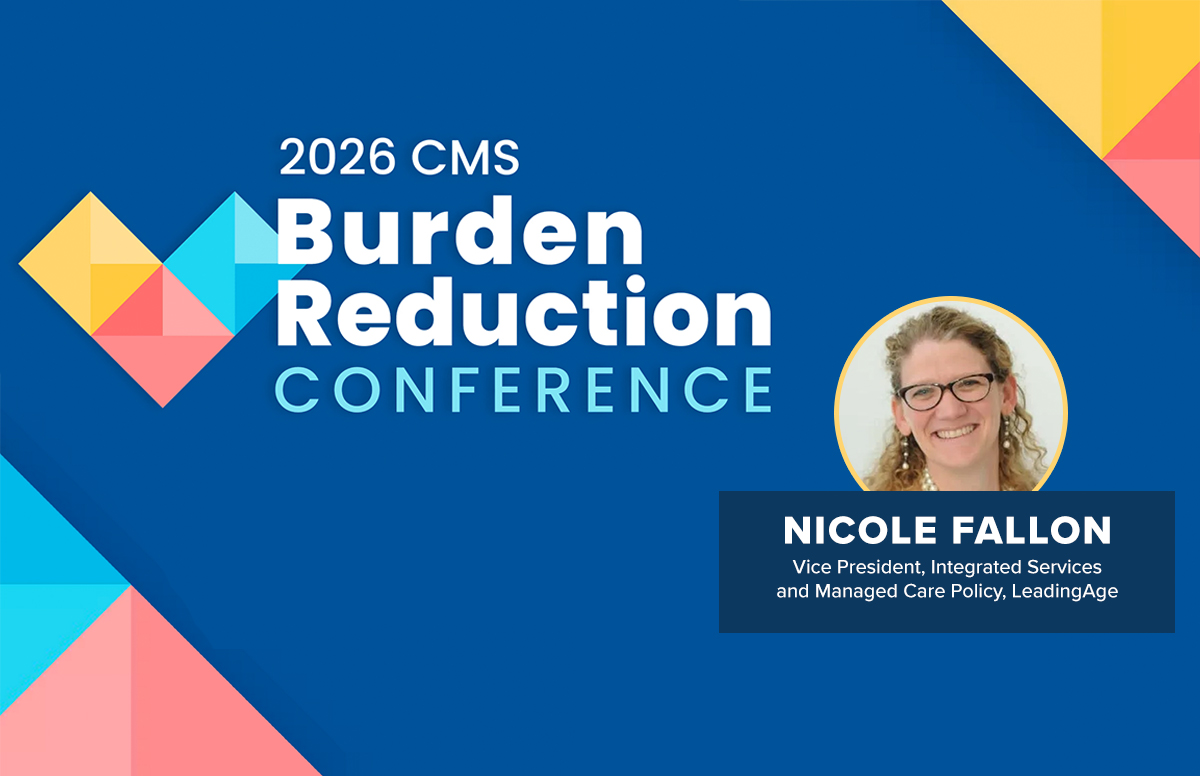
While in the company of Administrator Dr. Mehmet Oz and other CMS executives, health care technology experts, vendors, academics, and advocates like me, the February 25 conference offered a meaningful platform to showcase long-term and post-acute care providers’ critical role in older Americans’ access to care and chronic care management. Unfortunately, far too often the contributions of LeadingAge members and others go unrecognized.
Changing that is one of my professional goals–and a LeadingAge priority–because delivering truly integrated services to older adults is not the work only of physicians and hospitals. The role of all contributors to health care outcomes must be acknowledged and rewarded appropriately.
As one of four panelists focused on transforming chronic care, I emphasized that aging services providers are not just participants in integrated care models—they are often leaders. Not only do they participate in, they frequently steer institutional Special Needs Plans (i-SNP), Programs for All-Inclusive Care for the Elderly (PACE), and other important care models. Even with limited leadership opportunities within current Center for Medicare and Medicaid Innovation (CMMI) models, LeadingAge members are piloting forward-thinking initiatives like the Connected Communities program in rural Minnesota and TANDEM365 in west Michigan, among others. In both of these examples, aging services providers act as critical connectors across the health care continuum and within the broader communities–collaborating with social workers, chambers of commerce, and even farmers’ markets to address social and health needs holistically.
I also spoke candidly about the limitations of today’s accountable care organization (ACO) payment structures. While ACOs are designed to reward coordinated, lower‑cost care, savings are still calculated within the traditional Medicare fee‑for‑service framework and typically accrue to the providers leading the ACO—most often physicians and hospitals—rather than to those generating the savings. Nursing homes and skilled nursing facilities frequently produce savings by reducing lengths of stay and preventing hospitalizations and rehospitalizations, yet they rarely receive any share of ACO savings.
Medicare‑covered skilled nursing facilities are paid on a per‑diem basis, so shorter stays generate system savings without additional financial reward to the facility. Similarly, nursing homes caring for long‑stay residents may help an ACO avoid costly hospitalizations by delivering more intensive care in place, but again see little financial benefit. In contrast, hospitals paid under diagnosis‑related groups (DRGs) realize savings only by avoiding admissions altogether, not by shortening inpatient stays. Yet, as leaders of the ACO, they often receive a share of the accrued savings. I made the case to the audience that all those who contribute to lowering cost of care and improving quality outcomes should be financially rewarded.
This is why LeadingAge, for many years, has advocated for payment models that better recognize the contributions of aging services providers. Now, CMS is nearing implementation of a new ACO pilot that shows promise. We are optimistic about a new provision, known as CARA (CMS-Administered Risk Arrangements), within the Long-term Enhanced ACO Design (LEAD) model. CARA, which is slated to begin January 1, 2027 has the potential to accrue the financial benefits of value-based arrangements to a broader range of providers, including nursing homes and home health agencies. It’s great to know that our patience is being rewarded!
Also during the panel, a workforce-focused point surfaced that truly resonated with the audience. My fellow panelists raised the importance of providers working to the top of their license. While emphasizing my agreement, I also noted that this empowerment means little if we do not also encourage staff to share insights about patients and ensure that direct caregivers’ voices related to patient needs are truly heard and respected. Often these staff don’t believe they should challenge decisions of other providers, like doctors, even though these staff have critical information about the patient. Many provider attendees later shared with me how validating that message felt.
The conference concluded with a focus on data and technology—how to reduce administrative burden while improving care. CMS leaders expressed interest in using technology to help patients become experts in, and owners of, their own health data. I also encouraged broader thinking about data capture beyond the initial visit, suggesting ambient listening technology be explored for potentially documenting observations from certified nursing assistants and dietary aides. These staff often notice subtle changes in gait, speech, eating, or cognition long before they become acute issues.
One of the most striking moments came from Chris Klomp, chief counselor at the Department of Health and Human Services and head of CMS’ Center for Medicare. He shared an anecdote about his 65-year-old neighbor’s struggles to enroll in Medicare—underscoring how confusing options and administrative barriers can be for beneficiaries, and reinforcing the urgency of practical, people-centered solutions.
The conference’s take-away–that the possibilities for improving chronic care are truly vast and both high-tech and practical solutions are needed to better serve the chronically ill–is no surprise. What must be absorbed and internalized is that the potential to help make positive change is real. We must continue our advocacy by sharing LeadingAge members’ experiences to inform redesigning care and further reducing the administrative burden of delivering services to older adults. We also must continue to push, to break down the silos to build a better model. Together, I believe we can make a difference.

 TEP Report Hints At Home Health Value Based Purchasing Potential Changes