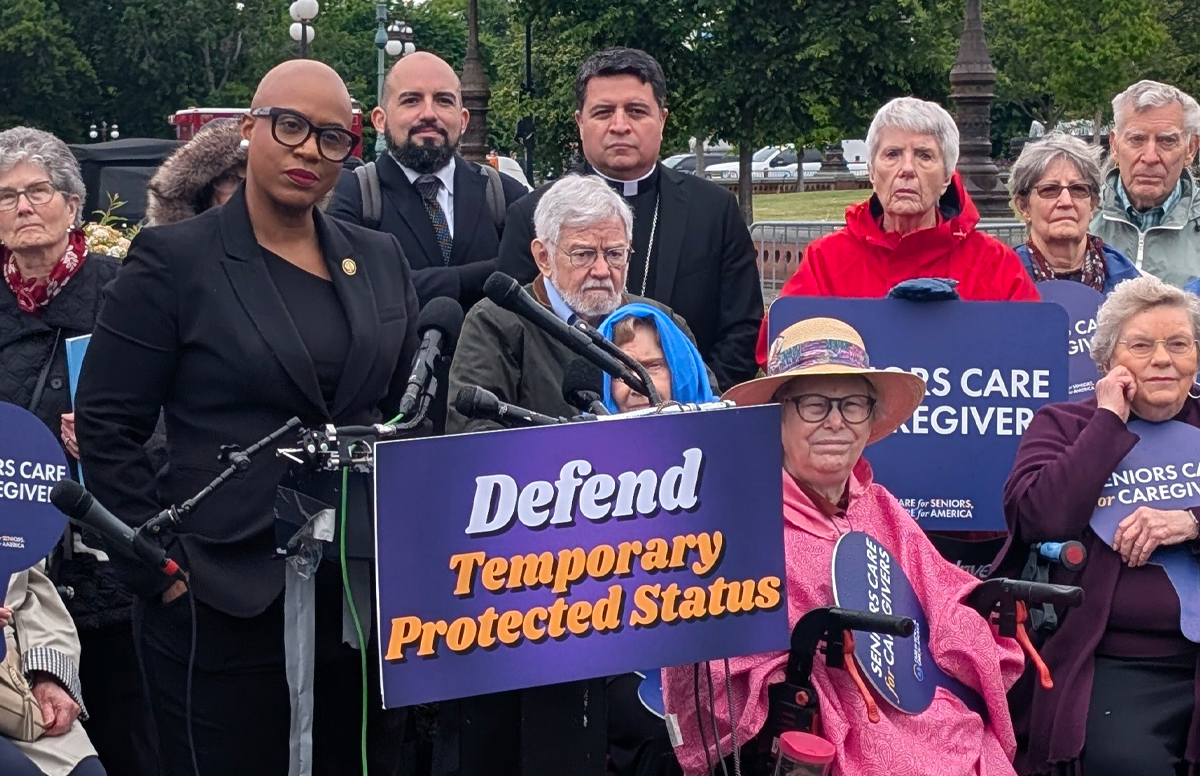
Residents and leaders from LeadingAge members joined advocates and lawmakers on Tuesday, April 28, 2026, at a Capitol Hill press conference urging the Supreme Court and Congress to protect Temporary Protected Status (TPS)—and the immigrant caregivers many older adults rely on every day.
With the Supreme Court set to hear oral argument on April 29 in a case tied to efforts to end TPS for Haiti and Syria, aging services providers, older adults, lawmakers and other advocates warned that abruptly disrupting work authorization could exacerbate current staffing challenges.
“Terminating TPS is not only bad policy that would have catastrophic consequences for our communities, our seniors, and our economy. In this case, it is also unlawful. As I close, I’ll just share my own story. It’s not a unique one. This is deeply personal. It is not political,” said Congresswoman Ayanna Pressley (MA-07, pictured at right). “In the final weeks of my mother’s life and her CLL cancer battle, it was Haitian nurses. Haitian nurses who prayed over my mother. who sang songs to my mother, who oil her scalp lovingly, and braided her hair. Everyone who calls this country home benefits from TPS and stands to be harmed by this termination. So together, we will continue to defend our TPS holders and their families, to center their humanity and dignity and to fight for what is just.”
For providers, the stakes are practical and personal: foreign-born employees are valuable contributors to the sector. They comprise over 30 percent of the home care, nursing home housekeeping and maintenance workforces and more than 20 percent of the nursing assistant and residential care aide workforces. Stable, experienced caregivers ensure care continuity, and help residents and patients stay safe, connected, and supported.
Organized by member Goodwin Living and Care For Seniors, Care for America, a coalition that includes LeadingAge, the event took place at the House Triangle in Washington D.C., and brought together older adults, providers, caregivers, and advocates calling for common-sense steps to stabilize and grow the caregiving workforce.
In addition to Rep. Pressley, participating elected officials included Sen. Edward J. Markey (D-MA), Sen. Lisa Blunt Rochester (D-DE), and Rep. Debbie Wasserman Schultz (D-FL). Speakers pressed policymakers to defend TPS ahead of the Court’s scheduled oral arguments and following recent House action related to extending TPS for Haiti.
LeadingAge members were front and center. Speakers, including Virginia residents Pierre Shostal of Goodwin House Alexandria and Rita Siebenaler of Goodwin House Bailey’s Crossroads, along with Todd Andrews, chief operating officer of Frederick, MD-based Asbury Communities, Inc., underscored the negative outcomes of de-documenting TPS holders, such as the loss of valued employees, including caregivers who build trusted relationships to provide in-depth care for older adults.
“My wife, Hilary, and I have lived at Goodwin House for the past 15 years,” said Goodwin House Alexandria resident Pierre Shostal. “And in that time, we have witnessed the indispensable roles that our staff members, of whom more than 35% are immigrants, play to support us in this last phase of our lives. In our nursing centers, 90% of the care partners are immigrants. Indeed, without our immigrant team members, I believe there is no way that Goodwin House could provide the essential services needed by them.”
Goodwin House Bailey’s Crossroads resident Rita Siebenaler added: “Do not deny us these valuable care costs. When you’re young, you rely on your health and your fitness, but as you age, in spite of your good habits, your body fails. We here together are examples of that to some degree. And yet we made the effort to come because of the critical importance of protecting our immigrant caretakers and TPS holders. Whether living in our own homes or living in a senior community, we rely on help. Some assistance, of course, comes from families. But often that assistance comes from the caretakers who come from other countries, who work as companions, as nursing aids, as occupational therapists, as dietary aids, as drivers to medical appointments, et cetera, et cetera. I am very fortunate to live in a wonderful senior facility.”
Members of the caregiver workforce and the union representing many home care workers also spoke in support of protecting TPS.
“We are in the midst of a crisis and are pushing out the workers. In Virginia, we have about 28,000 home care workers. And in 2032, we are going to need an additional 124,000 home care workers to meet the demand of our aging population,” explained Athena Jones, Homecare Chapter Chair, SEIU Virginia 512. “Because you cannot move and move caregivers and expect the system to survive. You cannot provide dignity to seniors by dismantling the system and workforce that provides the care. This is a breaking point. We need real solutions, solutions that recognize humanity and the labor of the workforce. This means pathways to citizenship. This means protection, not persecution. Because this is bigger than any policy. This is about who we choose to value. And today, I stand here with our seniors. I stand here with our caregivers. I stand here with all great immigrants that have sacrificed to be here to make a better life for themselves. History continues to prove that if you remove people who care for this country, you are not protecting it, you are dismantling it.”
For aging services providers, the issue is immediate: the end of TPS will result in the loss of legally authorized caregivers; without staff, providers may be forced to limit admissions. For older adults, this can translate into longer waits for services, and disruptions to the trusted connections that support older adults’ health and independence.
“By 2030, more than 70 million Americans will be over 65. The equation is simple. We need more caregivers,” said Todd Andrews, chief operating officer, Asbury Communities, a LeadingAge member in Frederick, MD. “We need more to support the ones we have already. Let me be clear. This is not about job displacement, as you’ve heard. It’s about supply and demand. The jobs are here. We have positions open today. We would hire immediately. But many Americans are not entering these roles at a scale we need. Others are. And many come from cultures where caring for older adults is a shared responsibility. They bring attentiveness, skill, and commitment. They are prepared for this work, and they do it exceptionally well. Because great care depends on consistency, desire, and willingness to give oneself to one another. A caregiver who sees the same resident every day notices patterns, how they move, how they eat, how they engage. And one day, something changes, just slightly, and because they’re good at their job, they catch it. That moment can prevent a fall, avoid hospitalization, or stop something small from becoming worse. That only happens through trust and love for the responsibility they have. Across this country, many people are promoting consistency for immigrants. It’s not incidental, it’s essential, because when the workforce is disrupted, the impact is immediate. Residents can feel it. Families can feel it. Our care teams need it. So if we know demand is growing, and we know this workforce is essential, we know disruption has real consequences. We need policies that support stability so caregivers continue to work legally, reliably, and without interruption.”
LeadingAge will continue to elevate member voices and advocate for policies that strengthen—rather than destabilize—the caregiving workforce.



 Direct CARE Opportunity Act of 2026 Introduced in House