
Lobby Day: Members Speak Up, Educate, Defend and Represent
Shaking hands, making eye contact, sharing stories with members of Congress, and staff–establishing connections and forging relationships is the heart of every Lobby Day, an annual LeadingAge event in Washington, DC. On Wednesday, April 22, nearly 300 members and state partners journeyed to the Hill for meetings. For some, the day marked their first visit; for others, it was a familiar and valued part of their long careers dedicated to aging services.
“It’s really important that our voices are heard now,” said Karen Stran, chief operating officer, Seniors Resource Center, a provider of community based services in Wheatridge, CO. “Home and community-based services is such an easy target; it’s not a mandatory part of Medicaid. And now, with states suffering under budget cuts, it’s an easy [target] that just keeps rising up.”
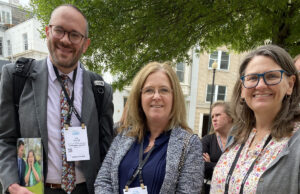
Stran, along with fellow advocates Eben Ezer Lutheran Care Center CEO Shelly Griffith and Joe Dubroff, who leads government affairs at LeadingAge Colorado, was well-armed for meetings with five Senate offices. Colorado is the second-fastest aging state in the country, noted Dubroff, while Ebenezer’s Griffith summarized the providers’ collective situation: “Our senior population is growing; the need for senior living services is growing. So is acuity. We’re continuously expected to do more with less resources.”
For member Regina Farrell, vice president of health services and chief clinical officer, Meadowood in Lansdale, PA, the importance of connecting with elected officials while in DC is a no-brainer. “Who else is going to do it, right?,” she asked, referencing LeadingAge policy chief Linda Couch’s breakfast pep talk earlier that day: In 2024, Couch told members, the federal government spent more than two trillion dollars on Medicare, Medicaid, housing and workforce programs. “There is no alternative federal universe that’s really in charge of reforms, improvements and funding. How else will change happen if Congress is not aware of and compelled to take action?”
Patty Morse, president and CEO, Connecticut Baptist Homes, and LeadingAge CT and RI board member, agreed. “We have a great relationship with a lot of our representatives and senators; they count on us for our input and we’re really proud to do this work. For some of us, this is our 10th year back for this program… we just cannot stop expressing ourselves and our concerns for all of the older people that we represent. Pretty soon we’re all going to be among that population.”
In person visits, said Morse’s advocate colleague Michael Smith, president and CEO, LiveWell in Plantsville, CT, can present an opportunity for education. “What’s nice is that a number of [elected officials] do call upon those of us who have visited,” he said. Sometimes, for instance, “there’s a new staff member who needs to get an orientation about what happens, particularly with older adults. I think we’ve been a good resource.”
On the be-an-educator theme, Ross Wilkoff, senior living administrator at Archie Hendricks Senior Skilled Nursing Facility in Sells, AZ, observed that the demographic shifts happening in our country are not widely understood. “There are 6.8 million job openings. Fully 20% of them are in health care, and there are a million-plus jobs for hands-on caregivers. No one seems to worry about that until it’s their loved one, who says the nursing home is short staffed…then it’s an emergency.” The message he shared in meetings in the offices of Arizona Senators Mark Kelly and Ruben Gallego, and Representatives David Schweikert and Adelita Grijalva: “You have to have a live human being … It’s not a hiring problem. It’s a caregiver shortage problem. … we need to address real immigration reform.”
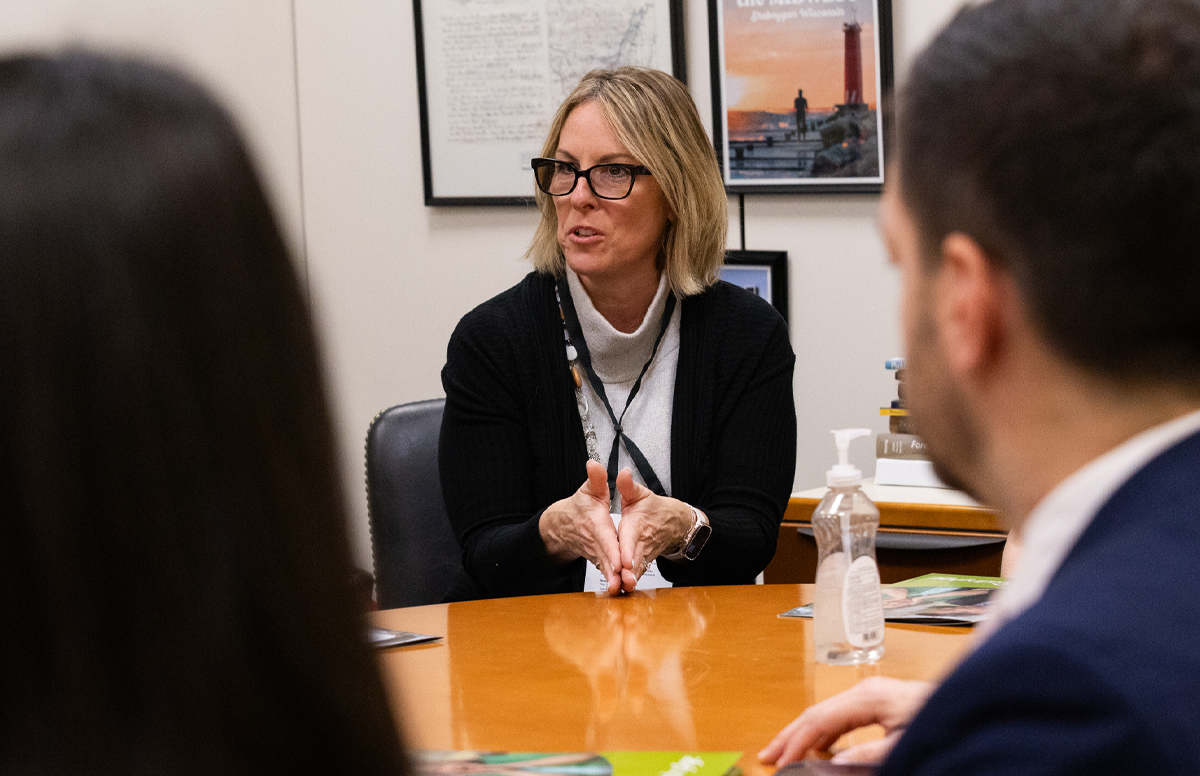
Being present at the DC-based meetings was, for Michelle Godfrey (pictured above, at right), a LeadingAge Wisconsin board chair and president and CEO, Attic Angel in Middleton, WI, the opportunity to ensure residents’ and employees’ stories were heard, “above and beyond [having conversations about] bills and statistics. … I’m really excited to return [to Wisconsin]; a lot of my residents have been emailing me throughout the week and sending me … good luck and encouragement,” she said, adding, “We have very active residents in politics.”
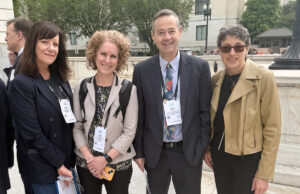
Indeed, it is members’ connections to their communities—that lived experience—that makes an impact, notes LeadingAge board chair Christie Hinrichs, president and CEO of Frasier, a life plan community in Boulder, CO, in this post-Lobby Day video message: “We do not need perfect words to tell a true story. Our credibility comes from the communities we serve, from the work that we do, from the workforce we fight for, from the older adults and families whose lives are shaped by these decisions.” All told, nearly 200 meetings—60 with Senate offices, 134 with House offices—took place on April 22; at 29 of those, Representatives or Senators attended.
Of in-person advocacy’s value, summed up Shaun Smith, president, Albright Care Services, part of Frederick, MD-based Asbury, “You can’t assume that people know anything related to senior services … people don’t think about it until they need it.” And when they do, that’s when the realization hits: “Maybe this is underfunded.” To illustrate what the services are, when sharing stories with elected officials, he said, “we always ask them” to come back to the community. “Advocacy is the hope you can draw focus, and get attention.”
Most Recommended
Recently Added

October 20, 2026
 HUD Reopens Immigration Verification Reporting

October 19, 2026
Long Term Care Financing RFI Released by Senate Finance Committee


October 14, 2026