More Than a Game: Resthaven Helps BrainGymAI Founders Explore Senior Living Market
For six weeks last summer, The Clubhouse, a gathering space in the Farmstead at Resthaven, a LeadingAge member in Holland, MI, had two bright purple kiosks set right next to its bay windows.
These stations, called BrainGymAI, drew the independent living (IL) residents and staff interested in trying the interactive platform, which challenges reaction time, focus, coordination, and other cognitive skills through exergames including Pick and Place, Hit the Bell, Paint, and In Balance.
BrainGymAI is a cognitive engagement platform launched earlier this year by Kurt Hüttinger GmbH & Co. KG, headquartered in Schwaig bei Nürnberg, Germany. The company’s kiosks are located primarily in science centers as well as fitness and wellness spaces. While its product is intended to sharpen cognitive skills for participants of all ages, after CEO and co-founder Marco Spiegl learned about LeadingAge’s Entrepreneur in Residence (EIR) program, he saw an opportunity to pilot BrainGymAI in a new way: with older adults.
“I immediately liked [the EIR] because it was really a possibility for me to experience life in senior living; we are from Germany and the whole senior living program isn’t really there. [Our country has] a completely different system that’s more about care and not at all what you mean here by active aging, independent living, and assisted living,” said Spiegl. “And it’s so important to really know your customers and co-create solutions with the people you aim to serve.”
The introduction of BrainGymAI to Resthaven began with a preliminary meeting with residents prior to Spiegl’s arrival. “We worked really hard before Marco got here to provide different opportunities for residents to understand what the EIR program was and to let them know they might be seeing some additional people around,” said Abby Waldo, vice president of innovation and product implementation. “We also educated residents via email, paper letters, in-person meetings, and one-on-one conversations.”
In addition to residents of the Farmstead, residents at Resthaven’s other IL communities, the River Place and the Warm Friend, were also invited to try BrainGymAI. “We provided daily transportation from those two communities to the Farmstead, so that way, residents had the opportunity to participate,” said Waldo.
Spiegl spent a week at Resthaven, installing the stations, meeting with residents, then “training the trainers” to help staff assist residents on navigating BrainGymAI. Spiegl returned at the end of the six-week pilot program to solicit more feedback and remove the stations.
During his meetings with residents, Spiegl worked to address concerns. “We had a two-hour session where we introduced BrainGymAI—we talked about the science of cognitive training and how BrainGymAI works,” he said.
He was not surprised that the majority of residents’ questions focused on data protection. “They wanted to know how we handle personal data, do we sell information to insurance companies or the state—all very important questions,” said Spiegl. “We were very well prepared to talk about this with them because data protection is a very [important] topic in Europe. We could give them good answers so they were able to trust us and participate in our study.”
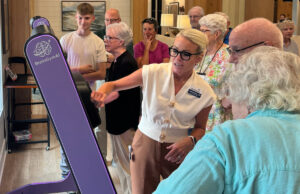
Spiegl held onboarding sessions with about 90 residents, and later with staff. The onboarding process “offers so much feedback,” he said. “You can see exactly what people understand immediately, where they struggle, where they ask questions.”
Spiegl gathered all of that initial feedback, resulting in over 30 feature requests for BrainGymAI developers. The Resthaven residents’ responses have already led to platform improvements such as little “helpers” to help guide the player through a game, and more tutorials at the beginning of a session. The developers also have plans to incorporate more engagement systems, such as rewards for high scorers. Ryan Glatt, a brain health coach and director of the FitBrainSM program at The Pacific Neuroscience Institute in Santa Monica, CA, who consulted with Spiegl on BrainGymAI and also participated in a presentation on cognitive health at Resthaven, will analyze data from the Resthaven BrainGymAI kiosks to help Spiegl and his team determine opportunities for further improvement.
“I think the residents enjoyed trying something different—the program was appealing to people who like to play games and stay on top of their health and well-being,” said Waldo, who estimated that a total of more than 70 residents participated, with 20 to 30 participating consistently throughout the pilot program. Spiegl emphasized that BrainGymAI is not a cognitive assessment tool, but is a gaming experience.
In addition to gathering feedback from residents on the platform itself, Waldo said Spiegl was also interested in learning the operational feasibility of implementing a tool like BrainGymAI in an IL community, and what type of communication is needed, with staff and residents, to make this kind of program successful.
Another area Spiegel hoped to explore through the EIR: how BrainGymAI affected residents’ moods and socialization with others. It’s accessible to all ages, including people with visual impairments, and wheelchair users.
“We wanted to build something like a fitness studio, where you can go and train in groups or on your own,” he said. “It really was the intention to get people together to challenge each other and instruct each other. That’s really one of the main design ideas of the whole thing, to make BrainGymAI a real meeting point in the community.”
According to Waldo, while many residents enjoyed spending time with BrainGymAI, some were more cautious. They “really didn’t like to participate with many people around them, maybe just a spouse or a friend,” she said. “I pictured people kind of crowding around and encouraging each other, but we didn’t see that as much. I’ve heard some comments from residents about how they got nervous if other people were watching, or that it was distracting to have other people around.”
Spiegl acknowledged that placement of the stations is a factor to consider. “At Resthaven, the kiosks were in a nice location, but it was a very open space. Some people may not have felt protected enough to do their training there,” he said. “On the other hand, it was a place where everyone passed by, saw the stations, and got curious.”
After reviewing residents’ responses, he believes that group training could make a difference for those hesitant to participate, noting that “with a good trainer, you could bring them out to meet the same people every week or maybe make new friends.”
Spiegl and his team are continuing to explore the U.S. senior living marketplace; in addition to participating in October’s LeadingAge Annual Meeting 2026 Expo, they brought BrainGymAI to the International Conference and Expo on Active Aging in Orlando, FL in mid-November.
Resthaven’s Waldo considered the EIR program with BrainGymAI a success and met the goals the community hoped to achieve.“We feel like we have a lot of valuable information to give to people who are developing programs, products or services for seniors,” she said. “I feel like we have really good inside information, if you will, about what our seniors need and what our industry needs.”
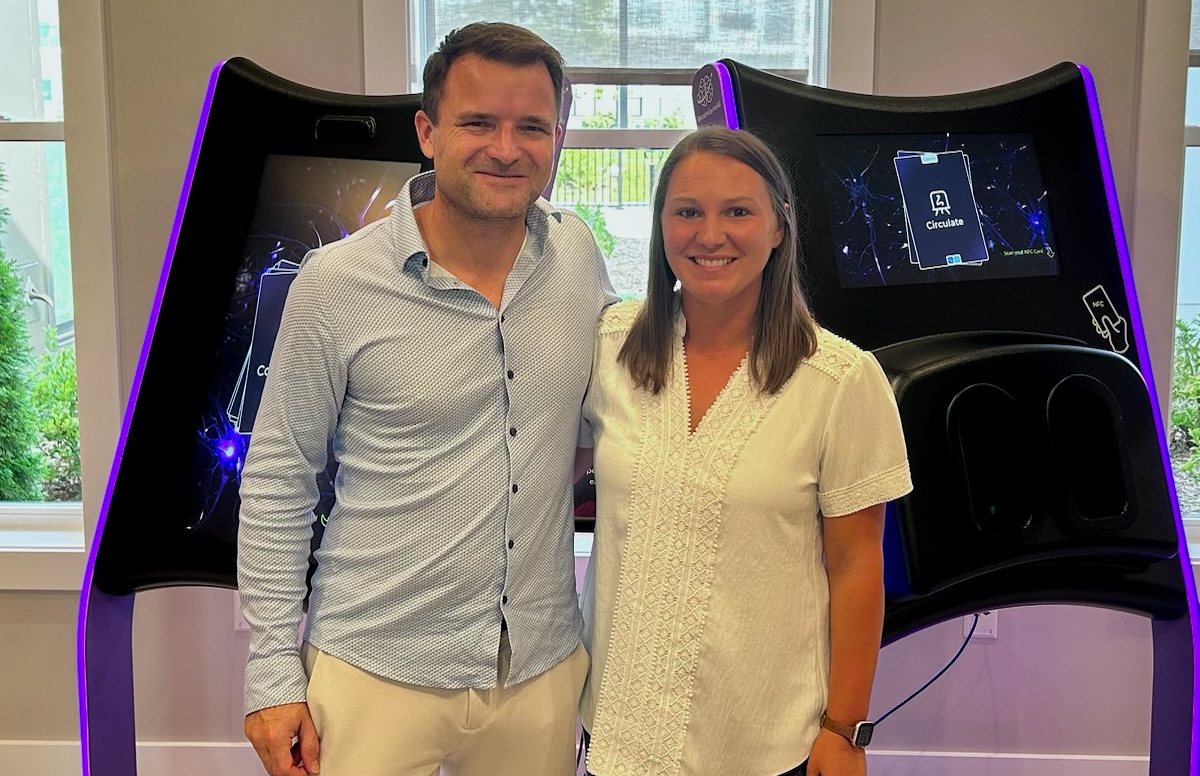
Pictured above right: Marco Spiegl, co-founder of BrainGymAI and Abby Waldo, vice president of innovation and product implementation at Resthaven.
 Midterms 2026: What's Ahead With Democrat Majorities in Congress