The first point of contact for an applicant seeking a position with United Church Homes (UCH), a LeadingAge Center for Aging Services Technologies (CAST) Patron, is Alex, who will share the types of jobs available and in what locations, provide a ballpark figure on pay rates, and answer questions. Alex will gather the applicant’s name, career details, and other information and set up the next step—an in-person interview with a UCH recruiter.
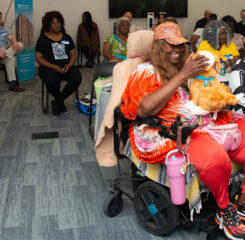
Alex (pictured, right) is an efficient team member. Alex is also an AI Mascot™, built for UCH by WiseOx, a tech company specializing in artificial intelligence (AI) created mascots for many organizations, including senior living.
AI adoption in the sector is growing. According to a 2024 report from LifeLoop, a LeadingAge Bronze Partner with CAST Focus, approximately 9% of senior living operators were using AI. By 2025, the number had grown to 36%, with an additional 35% planning for AI. Currently, AI is typically implemented for staffing efficiency, data analytics, and recruiting.
The introduction of Alex into the human resources recruitment workflow at UCH quickly had an impact, according to Beth Craig, corporate director of recruitment and retention.
“We started working with WiseOx in June 2025 and had the product basically up and ready by August,” said Craig. “Some of the guardrails [safety frameworks around policies, monitoring and technical controls] are still on for now. And updating Alex will be an ongoing thing.”
Training Alex
Getting Alex ready to interact with applicants required work. “We spent weeks and weeks, alongside WiseOx, training the AI mascot on all things, not only UCH, but all things that are part of our recruitment practice,” said Craig. Alex needs to know the latest details on the organization’s job openings, pay rates, and more. To train Alex, Craig continually uploads documents, directs Alex to websites, and even emails the mascot directly. “We just had a change in pay and I sent Alex [the update],” she explained.
Then, once she and her team at UCH headquarters in Marion, OH, were confident in Alex’s capabilities, “we went a step further to make sure that every UCH community has its own bespoke training platform for Alex,” said Craig.
Alex has been trained to answer questions concisely so that they are easy to read on a phone screen. Can Alex email or text with an applicant? No, not yet. “WiseOx is working on that,” said Craig.
Fritz Brumder, co-founder and CEO of WiseOx, said there’s “a pretty slow adoption curve” in the aging services industry with AI, but the landscape is changing. “A lot of organizations are taking a wait-and-see strategy, but even in the last two years, we are seeing fewer people hesitant to use AI,” Brumder said.
AI Mascots like Alex, known as personas, are implemented by the majority of WiseOx’s clients–over 80%, according to Brumder. “We push people in that direction because the mascots really are built to be team members.” Although Alex appears as a millennial woman, Craig said the messaging on the UCH site is very clear that Alex is AI. This hasn’t stopped some applicants arriving for interviews to ask to see Alex or say, “tell Alex I said hello.”
The level of efficiency AI brings to the recruitment arena is notable. “Alex is meant to connect with applicants much more quickly,” said Brumder. “We talked [with UCH] about ‘speed to lead,’ which is the time to respond to an applicant so they don’t go somewhere else for a job.”
“Human In Loop”
A key element to working with AI in recruitment is the necessity to have a “Human In Loop,” as Craig calls herself.
“At the end of each week, I get an email with all the information about people who interacted with Alex. I can make sure our level of customer service was met.”
“We’re using Alex to communicate with people as much as we can,” she continued. “I don’t need to have 15 people on staff to answer these questions.” Craig is satisfied that initial interactions between Alex and UCH candidates are as effective as they would be with an in-person recruiter.
After Alex engages with a candidate, said Craig, “I can forward the entire conversation between Alex and an applicant to a building’s HR manager. They can see what the applicant has been asking about. The applicant can walk in knowing the employer value proposition—from medical, dental, and vision to the start date.”
As she continues to work with Alex, Craig contemplates future uses.
“We’re just talking about recruitment. What if we [used AI] for admissions? I also look at what I could do with an AI Mascot trained in scheduling—that’s the toughest job that people have in [continuing care retirement communities] and nursing homes,” she said.
“I think that if you don’t start using AI, you’re going to be left behind,” she added. “Look at the business case of what it can do for you, how it can make you and your teams more efficient.”


 Shutdown Week Three: Impact of Ongoing Closure on Affordable Housing