AI Training Works Best When Led by Employers
While artificial intelligence (AI) sounds full of theory, thought leadership, and a bit of magic, employers are the ones who will bring AI into on-the-ground reality. That was my main takeaway from the recent congressional hearing Building an AI-Ready America: Strengthening Employer-Led Training. Employers—including aging services organizations—are best positioned to look at AI’s capabilities through a practical lens, see how AI tools can assist their workers with day-to-day-tasks, and use AI to empower their staff.

Across the congressional testimony, a clear theme emerged: the most effective AI training is shaped by employers, tied to real work, and built around the actual skills people need on the job. “When businesses are directly involved in designing training programs, we get better outcomes,” said Subcommittee Chairman Burgess Owens (R-UT). “Many employer-led or employer-involved models allow Americans to earn while they learn. Those models build practical skills tied to real jobs. … An AI-ready America won’t happen by accident. It will happen when we align training with real job demands ….”
That is exactly the approach aging services should take. If aging services organizations want to use the power of AI to solve workforce challenges effectively, they must prioritize AI and integrate it into their workforce. They cannot treat AI training as an optional side project, depend on a one-time webinar, or wait for someone else to figure it out for them.
AI readiness will be won or lost through practical learning designed in the field, not generic content. Aging services organizations that move fastest will be the ones that help staff build confidence using AI in real workflows, with clear guardrails, supervision, and a focus on better care and smoother operations.
How CAST Members Are Introducing AI to Their Staff
In our field, changing how work gets done does not mean every organization needs a team of AI experts. It does mean leaders, managers, clinicians, operations staff, human resources teams, and others need a practical understanding of what AI can do, where caution is needed, and how to use these tools responsibly.
LeadingAge CAST Patrons United Methodist Communities and RiverWoods Group, rather than relying on generic outside training, are being proactive. Building AI literacy across his organization is critical, explained Travis Gleinig, a CAST Commissioner and UMC’s vice president of innovation and chief information officer, at a July 2025 global roundtable with members of the Global Ageing Network.
His organization and RiverWoods Group have been providing AI workshops for staff within their own organizations, reinforcing the value of employer-led, field-informed learning shaped by the real workflows, risks, and realities of aging services.
RiverWoods Group first introduced AI-powered meeting transcription tools and then, after employee survey results revealed interest in learning more about integrating AI into the workday, expanded its training. The organization is taking a tiered approach, offering workshops for staff and senior leadership.
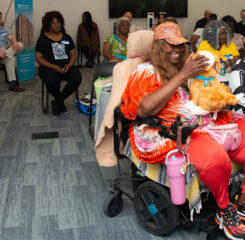
Last summer, for instance, RiverWoods conducted day-long workshops with approximately 90 staff from across the organization, including dining, facilities, housekeeping, and clinical care. Using guided, scenario-based examples, attendees learned how to utilize AI tools in the Microsoft Office Suite and gained a basic framework for effective prompting techniques. “We saw this as an ‘aha’ moment for our staff,” said David Lafferty, CIO of RiverWoods Group of the training. “The benefit and power of AI tools became very real once staff gained confidence in how to use them.”
Today, approximately 100 staff regularly use AI tools within chat interfaces and throughout the Microsoft suite, especially to draft emails, edit and revise documents, and summarize meetings.
“While these tasks barely scratch the surface of what AI tools can do, the reality is that for most front-line staff, these are the important tools to save time on administrative tasks, and spend more time interacting with residents,” said Lafferty. To integrate AI’s benefits throughout the organization, RiverWoods is actively developing advanced, interactive, and agent-based AI use cases that are far more sophisticated to increase efficiency at the senior leadership level.
Learnings Developed in the Field Are Key
As these examples show, generic training is not enough. The strongest learning comes from within: Employers understand where workflows in their organizations are breaking down, where staff need support, and where AI may actually help. They are far better positioned than outside observers to shape training that is useful, realistic, and relevant.
That is also why LeadingAge’s work in this area matters. Our AI literacy resources have been shaped with input from members and led by members who understand the realities of aging services. That includes our recent AI Literacy Essentials for Aging Services webinar, which offers practical guidance on generative AI for providers.
My view is simple: AI training in aging services should be employer-led, field-informed, and closely tied to real job demands. If we want staff to use AI well, we need to make AI literacy part of how we train, support, and equip our workforce. It is a workforce issue, and the organizations that act on that now will be far better positioned for what comes next.

Most Recommended
October 15, 2025
 Shutdown Week Three: Impact of Ongoing Closure on Affordable Housing
March 06, 2026
Fiscal Year (FY) Funding 2026
October 07, 2025
Immigrant Workforce Matching Program Brings Workforce Relief
Recently Added

April 08, 2026
CMS Clarifies Nurse Aide Training Requirements

April 08, 2026