Embracing, Making, Shaping Change: Annual Meeting 2026, Keynote Session Day 1
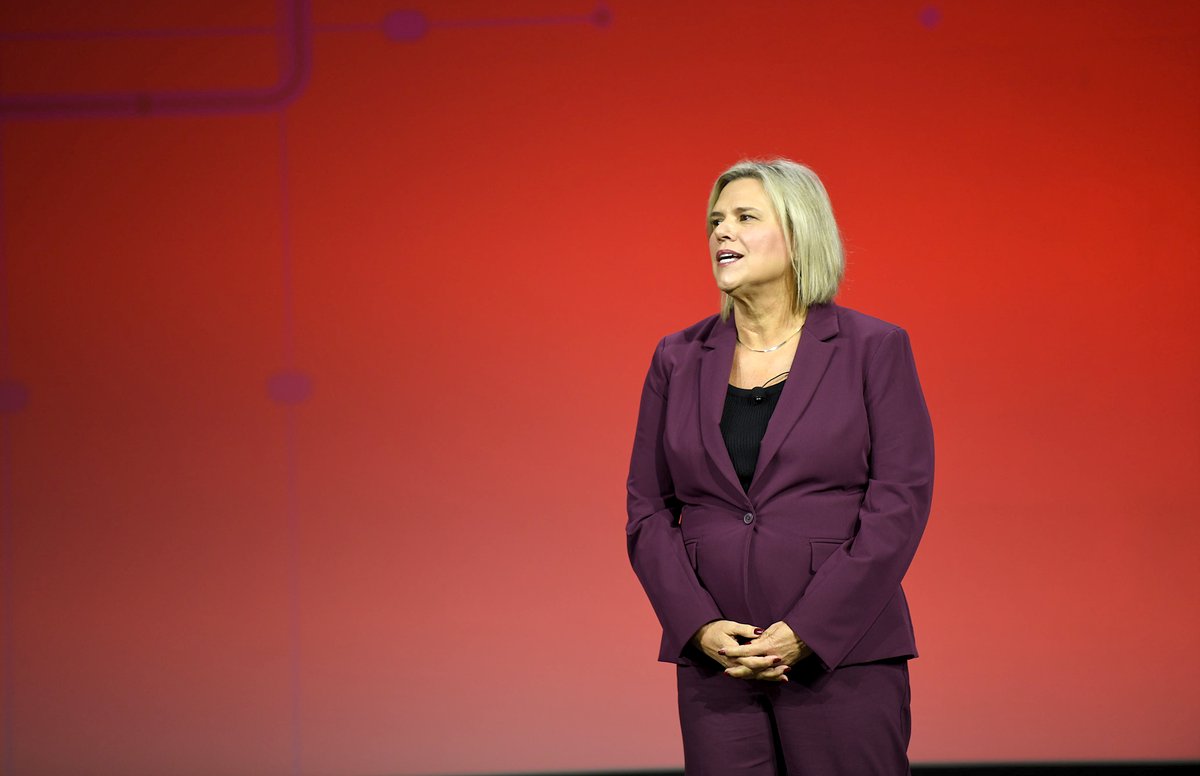
Change—those who make it, and how it is achieved—was front and center as LeadingAge board chair Christie Hinrichs welcomed over 6,000 attendees to the 2026 Annual Meeting on Monday, October 26.
Hinrichs, president and CEO of Boulder, CO-based life plan community Frasier, led the morning’s program, after which attendees heard updates on the incoming 2027 LeadingAge board and the CEO search committee’s progress, following the September 2026 announcement of current president and CEO Katie Smith Sloan’s plans to step down next March. Wharton School professor Ethan Mollick, who studies the effects of artificial intelligence (AI) on work, entrepreneurship, and education, rounded out the event and delivered on the meeting’s promise of “big ideas and actionable insights to help inspire your best work.”
LeadingAge Board Changes for 2027
Board Chair Christie Hinrichs
On stage at the Pennsylvania Convention Center, Hinrichs, who took the helm January 1 following her November 2025 induction, spoke frankly. “The longer I’ve spent in this field, the more I’ve come to believe that we’ve been looking at changemakers all wrong. Real change rarely begins with a title,” she said. “Real change begins with a belief: A belief that things can be better than they are today. A belief that a problem that has existed for decades doesn’t have to exist forever.”
“I’ve seen it in large organizations and small ones, in urban communities and rural communities, in organizations with abundant resources and organizations that are making every dollar stretch a little further,” she said. “What struck me wasn’t the size of the project or the sophistication of the idea. What struck me was the audacity.” Innovation, she added, starts with a question. And changemakers are people brave enough to ask it.
Recognizing the work of members who “inspire me most,” by their willingness to learn, to “ask difficult questions,” she lauded the multitudes of providers who have built what is today’s aging services sector by imagining a different future for older adults and not accepting the status quo, when “growing older was too often viewed through a lens of limitation.”
Rejecting those ideas, they imagined a future where aging was instead seen as a time of “dignity instead of decline, community instead of isolation, and purpose instead of irrelevance.”
Every community represented in this room, she said, is evidence of that imagination.
“That is our inheritance,” she stated. “And now it is our responsibility,” acknowledging the sector’s challenges. Those, she said, “are real.” At the same time, possibility is “also real,” she noted, emphasizing that it is “represented by every organization that continues serving older adults despite obstacles.”
Those who take action, who look at difficulty and decide to build anyway, who see uncertainty and decide to lead anyway, she said, are choosing hope—a form of action. “It is believing that our best days can still be ahead of us and then doing the work required to make that true.”
What makes her optimistic about the future of aging services? “The leaders, the caregivers, the innovators, the mentors, the problem-solvers, the people who continue showing up every day, determined to improve the lives of older adults. They,” she said, “are the changemakers.”
Improvements are made not by those who wait for permission, for perfect conditions, or for others to dip their toes in first. “A changemaker,” she said, “is simply someone who decides that the future can be better and is willing to help build it, by those who believe they can shape it: It is something history will say we created.”
LeadingAge Board Changes for 2027
The result of votes cast by LeadingAge members in September approved a board slate of new directors. Joining the board in 2027 are: Nadim Abi-Antoun, president and CEO, Presbyterian Living, Skokie, IL; Susan DiMickele, president and CEO, National Church Residences, Dublin, OH; and Christopher Tomlin, president and CEO, Methodist Homes of Alabama and Northern Florida, Birmingham, AL. Reelected to a second term are current directors, Mark Anderson, president and CEO, Vivie, Alexandria, MN; Colleen Frankenfield, president and CEO, Lutheran Social Ministries of New Jersey, Burlington, NJ; and Erica Thrash-Sall, CEO, Horizon House, Seattle, WA have each been reelected to a second term. Finally, Barbara Hughes Sullivan, national director, Village to Village Network, St. Louis, MO, returns as At-Large board member of the board. All new and continuing terms will begin on January 1, 2027.
The terms of directors Larry Gumina, chief executive officer of Ohio Living, Westerville, OH and Walter Ramos, president and CEO, Rogerson Communities, Boston, MA, conclude at the end of 2026.
CEO Search Update
Dave Gehm, President and CEO, Wellspring Lutheran Services and chair of the CEO Search Committee, reported that the selection of an executive search firm is in its final stages.

The selected partner will work with the committee fine tuning the process to clarify and focus the search. Noting the “dynamic, demanding, and fluid” future of the sector, the committee has set an aggressive timeline, with the goal of identifying LeadingAge’s next CEO by April 1, 2027.
AI Expert Ethan Mollick
Artificial intelligence’s (AI) ability and influence in reshaping how aging services organizations engage with residents, families, care partners and other collaborators is a given—but exactly how that will happen is a mystery. Speaker Ethan Mollick, professor and faculty director of Wharton Generative AI Labs, whose latest book, “Co-existence: The Next Phase in AI,” came out earlier this year, got a laugh from the audience with his admission that no one knows what’s next.

Reviewing AI’s developmental evolution, from pre-2022’s algorithms powered by private data today’s AI agents, Mollick gave a brief definition of today’s AI: models or AI brain (GPT-6, Claude Fable 5.1, Gemini 4 Argon); apps, the interface we use (ChatGPT, Claude, Gemini, etc); and the harnesses, or systems used to get work done and then explained the many ways that people and organizations work with AI. It is used as both a tool and a teammate; it can be sustaining and disruptive. After introducing the sobering “The Bitter Lesson,” Mollick explained the urgency for aging services leaders to harness their advantages of deep and wide knowledge; taste and agency; “learn and experiment.” The biggest challenge, he believes, is “how do we decide how to use it?”
Most Recommended
November 16, 2026
How Can We Become Changemakers after the Midterm Elections?
November 09, 2026
Listening to Frasier Meadows Staff and Residents Helps Entrepreneur Build a Better Product
November 04, 2026
 Midterms 2026: What's Ahead With Democrat Majorities in Congress
Recently Added

November 17, 2026
DOL Proposes Major Changes to Employment-Based Immigration Process
November 17, 2026