Goodwin Living Initiative Helps Participants Build Stronger Cognitive Skills
In 2011, Wendy Liebreich realized something was wrong with her memory. The wife, mother and grandmother was in her early 70s, growing forgetful and often repeating herself in conversations. Her simple math skills were failing—a bridge player, she noticed she was having trouble keeping score. The most frightening episodes occurred when she was driving in areas she frequently traveled and became lost. “It was alarming,” Wendy said.
After a series of tests, Wendy and her husband Howard learned that she had mild cognitive impairment, which affected her frontal cortex. After the diagnosis, she turned to her son, Rob, then working at Aegis Living in Seattle and now president and CEO of LeadingAge member Goodwin Living in Virginia, and asked if he knew about any programs she could start using to address her cognitive issues.
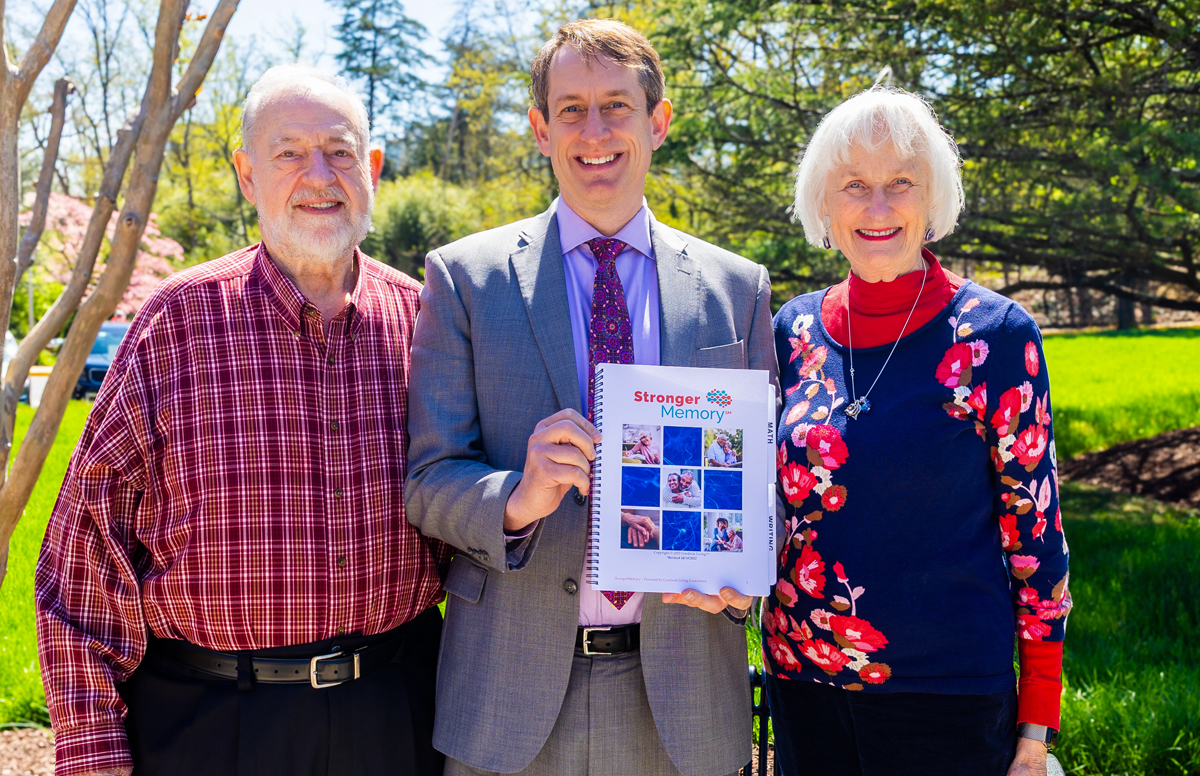
That initial conversation was the inspiration behind StrongerMemory, a clear and accessible brain health curriculum that has grown from its origins as a family project to a research-backed, open-access resource used not only by Goodwin Living, but by hundreds of partners, including other LeadingAge members nationwide, as well as libraries and senior centers in the Fairfax, VA region. It has not only positively impacted Wendy’s life, but the lives of thousands of others who also spend 20-30 minutes each day doing simple math problems, reading aloud and writing in a journal. In a series of YouTube videos about StrongerMemory produced by Goodwin Living, Wendy (pictured above with Howard and Rob) refers to her routine as “my homework” and says she never misses a day.
Initially, Rob learned about a program in Japan where adults with more advanced dementia improved their cognitive test scores by doing these types of reading, writing, and math activities. A student learning center in the United States was employing similar exercises and Wendy enrolled, becoming the oldest participant in her local program. She began seeing memory improvement after a month.
A Personal Endeavor
In 2015, Rob and his team started working on creating a similar program, eventually launching a pilot at Aegis Living. Staff began tracking enrollees’ cognitive scores, and improvement was noted. After Rob joined Goodwin Living, the Liebreich family donated the curriculum in 2020, where it became StrongerMemory, fully funded by the Goodwin Living Foundation.
“StrongerMemory really grew from a personal endeavor to a broad initiative,” said Jessica Fredericksen, who joined Goodwin Living in 2021 as senior director of brain health. “Through this program, we’ve reached 75,000 older adults and our goal is 100,000 by the end of this year, and one million at the end of ten years.”
StrongerMemory partners, which number over 300, include the Caregiver Action Network and the Village to Village Network; LeadingAge member partners include Covenant Woods and King’s Grant Retirement Community in VA and The RiverWoods Group in NH. Throughout Virginia, 90 nursing homes joined StrongerMemory, supported by Civil Money Penalty (CMP) grant funding via the Centers for Medicare and Medicaid Services (CMS). The program attracted 832 participants, and they were able “to capture some great stories,” said Fredericksen.
Research Results
In partnership with George Mason University in Virginia, Goodwin Living launched a pilot study in 2021. A group of 104 participants, many with mild cognitive impairment, began using StrongerMemory and showed improvement on the Mini Montreal Cognitive Assessment (Mini-MoCA) in memory scores. They also reported increased confidence in daily life and improvements in focus, recall, and engagement. StrongerMemory research was presented at the Gerontological Society of America conference and has also been featured in research studies published in SAGE and Innovations in Aging.
The framework of the StrongerMemory program is intended to be easy to complete in 30 minutes each day, with ten minutes devoted to each section: reading aloud (books, magazines, newspapers and other materials); writing by hand (journaling, grocery lists, letters and more); and simple math—problems are found in the StrongerMemory workbook, which can be downloaded for free.
While participants in StrongerMemory can work through the program on their own, the social component of meeting with other participants has proven to be key.
A Social Component
“Social connection is essential. In the second study that George Mason University did on StrongerMemory, a researcher had a group of participants do the exercises on their own and then as part of a weekly group,” said Fredericksen. “There was noticeably greater improvement for those who were part of a social group.”
As Goodwin Living notes in the facilitators’ materials, group leaders are encouraged to meet weekly with participants, giving them the opportunity to share their individual progress. Facilitators can offer ongoing brain health education, and also enhance group connections with activities like celebrating participants’ birthdays.
Since StrongerMemory launched in 2020, which was during COVID, Wendy began meeting with an online group—she’s still part of that group today, as are many others in that cohort who started doing the exercises together. Extolling the benefits of her ongoing dedication to StrongerMemory, Wendy said in the YouTube series, “I have the best focus and recall now than I’ve had in the 11 years I’ve been doing this.”
Another social connectivity element of StrongerMemory occurs when participants do their daily exercises in tandem with a spouse, adult child or caregiver. “For a person caring for someone with memory issues, StrongerMemory can help bring back positive interactions,” said Fredericksen. “They want to work through the program together.”
As Howard, Wendy’s husband, notes in the YouTube series, “When people see their loved one is able to communicate and remember things…the impact is far greater than you can imagine.”
Goodwin Living offers all training manuals and 178-page workbooks (which include math problems and writing prompts); providers can download and print PDFs of the facilitator guides and StrongerMemory workbooks for free, or they can buy them from Goodwin at cost.
Most Recommended
 TEP Report Hints At Home Health Value Based Purchasing Potential Changes
Recently Added


October 14, 2026
CAST Members in the News
October 14, 2026
Colleagues on the Move, October 14, 2026

October 13, 2026