Since mid-2025, Waqar Ahmad and Daniel Bonilla have been immersed in the aging services sector as the first cohort of the LeadingAge Aging Services Leadership Fellowship Program. LeadingAge, through a grant from the Next50 Foundation, launched the yearlong fellows pilot in partnership with The United Negro College Fund (UNCF) to raise awareness of career opportunities in the long-term services and supports (LTSS) sector and work collaboratively with LeadingAge members to connect new talent with mid- and senior-level roles in their organizations.
Training and Support
UNCF selected candidates through a competitive application process, and the employer interviewed and hired them as fellows for the one-year program. Each fellow received a full-time salary and benefits and was matched with a mentor to support their transition. Ahmad is working with A.G. Rhodes in Atlanta, GA. Bonilla served his fellowship at Parker Health Group, Inc., based in Highland Park, NJ.
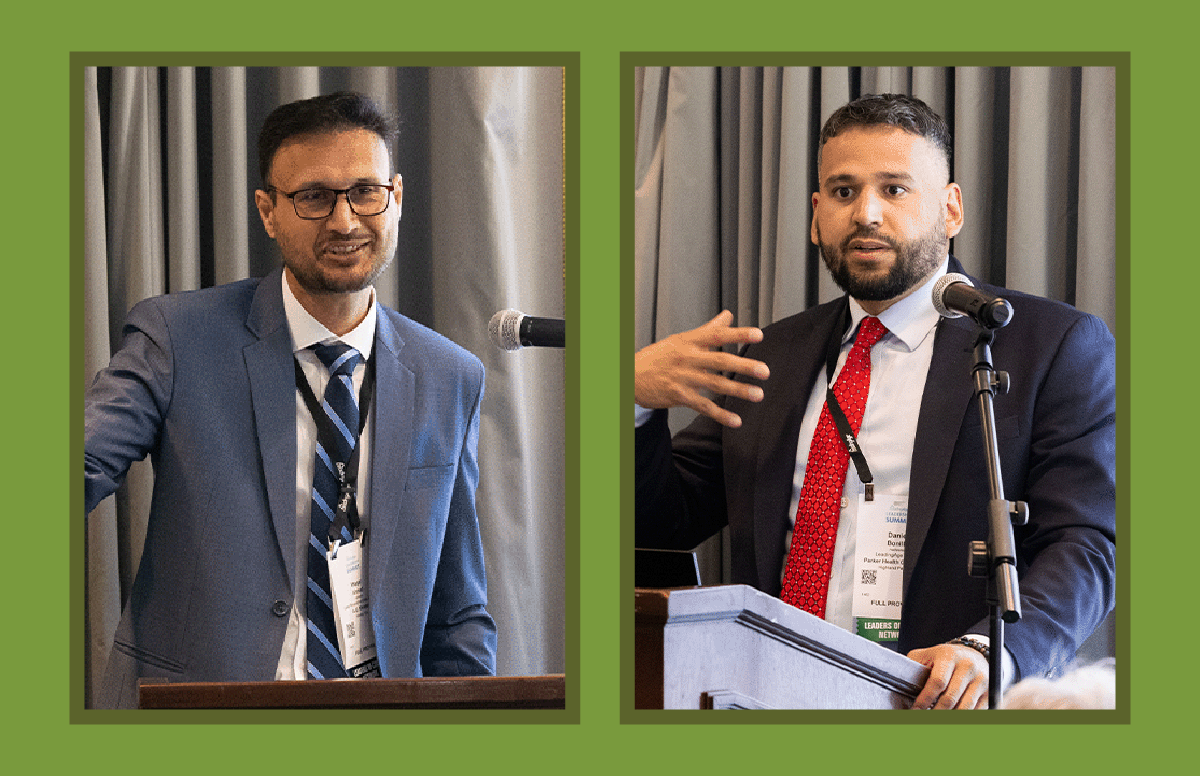
As fellows, Ahmad and Bonilla (pictured at right: Ahmad on left, Bonilla on right) participated in an aging services curriculum developed by the Erickson School of Aging Studies at the University of Maryland, Baltimore County (UMBC). The training aimed to broaden each fellow’s understanding of key topics and issues in aging services, support their transition into their new role and field, and help develop their leadership skills. They also participated in cultural competency trainings led by Attack the Glass, LLC, covering topics such as organizational culture, cross-cultural communication frameworks, power dynamics and trust, and inclusive leadership practices.
Meet the LeadingAge Aging Services Fellows
Waqar Ahmad, PhD
Lead Researcher and Data Analyst
A.G. Rhodes
“The fellowship offered me the space and opportunity to meaningfully connect research, leadership, policy, and practice.”
The LeadingAge fellowship allowed Waqar Ahmad to put his research and data analysis skills into practice while gaining knowledge about how aging services organizations operate.
“I had the opportunity to learn from leaders across the field and translate my academic training and research into practice that could positively impact residents and the workforce that cares for them,” he said.
Ahmad is a social gerontologist and sociologist. He holds two master’s degrees, one in sociology, which he attained in his native Pakistan. He received a second master’s degree in gerontology and a PhD in sociology from Georgia State University.
“Before coming to the U.S., I worked as a sociology professor, where I taught and conducted research on a variety of social issues,” he said. “Over time, my interest turned to aging, long-term care, and workforce issues in aging services.”
As lead researcher and data analyst, Ahmad is examining A.G. Rhodes’ workforce stability through real-time analysis of staff experiences and retention risk.
“I analyze survey data and translate the findings into leadership-relevant insights,” he said. “The goal is to help the organization identify specific areas of improvement and introduce targeted interventions.”
Ahmad has also been involved in the oversight and evaluation of internal quality improvement projects. “We have non-pharmacological intervention programs, such as music therapy and horticulture therapy,” he said. “Our goal is to assist those programs in order to know how they affect resident outcomes.”
Another segment of Ahmad’s role involves facilitating a partnership program between A.G. Rhodes and academic institutions, including Georgia State University and Georgia Tech. “Honestly, I believe this is where the fellowship gave me something I wouldn’t have gotten elsewhere,” noted Ahmad.
Ahmad has praise for the mentors he’s had the chance to work with, including Neal Martino, vice president of people and senior professional in human resources at Wesley in Boston, with whom he meets twice a month and shares research interests; Dr. Lee Ann Steffen, a gerontology professor at UMBC, who facilitates the aging services curriculum; and Nzinga Shaw, president of Attack the Glass, LLC and the facilitator of the cultural competency training, whom Ahmad says has been “a great influence.”
“What I’ve learned from the cultural competency curriculum has been central to my research work now,” he said. “As a researcher, I have come to understand that long-term care is serving an enormously diverse population, and any research that ignores that really has a blind spot. I think this fellowship helped me sharpen my lens—I often ask myself, ‘Whose experience is reflected in the data, and whose isn’t?’”
When asked about his view on the future of the aging services field, Ahmad said he believes it’s “a critical moment” for the field.
“The demand for aging services is accelerating faster than our systems,” he says. “There is an opportunity to better support the direct care workforce. We all know direct care workers are the backbone of aging services, but many organizations struggle with issues around recruitment, retention, career advancement, and employee well-being.”
This is where Ahmad believes his data experience can have an impact. “My research has taught me that the problem goes deeper—it’s how we’ve structurally devalued this work with low wages, lack of career pathways, and the emotional labor that nobody acknowledges,” he says, adding that investing more in research can help us “advocate for the direct well-being and empowerment of care workers at the policy level. Research-based advocacy can be used as a strong lever to influence policies in a positive way.”
Ahmad hopes to continue bridging the gap between research and practice, as he did during his fellowship.
“Too often, valuable research remains in academic journals,” he said. “Aging services organizations need researchers who can translate evidence into actionable strategies. That’s an area where I believe I can make a contribution.”
Daniel Bonilla
LeadingAge Aging Services Fellow
Parker Health Group, Inc.
“Everyone I’ve met in the aging services field is there for the right reason.”
Before Daniel Bonilla received his master’s degree in public administration with a concentration in nonprofit management and health care administration from Rutgers University, he worked as a clinical integration director at St. Barnabas Hospital in the Bronx, where he implemented a grant-funded program for 125 people who were living with Type 1 or Type 2 diabetes, COPD, heart disease, and asthma.
“I was tasked with helping them combat those conditions through an eight-week exercise medicine program, along with nutrition support,” said Bonilla. “I have always been fascinated by health—how can we not only get people to live longer, but live healthier. That was always a passion of mine, and it still is.”
Bonilla learned about the LTSS Aging Services Fellowship Program just before graduating from Rutgers. “I saw that part of the fellowship was leadership development and that I was going to be working with Roberto Muñiz from Parker Life,” he said. “I wasn’t aware how vast aging services was, and I saw this as my chance to work with a successful CEO and develop my leadership skills that way.”
For the first six months of the yearlong fellowship, Bonilla focused on learning about the aging services field by spending time with administrators from each of Parker’s nursing homes and with members of all departments. He spent the second half of the year working on projects and finding ways to contribute to the organization, he said.
“Before I started, I looked at aging services as making sure people are fed and that their other personal needs are met,” Bonilla said. “But now that I’ve spent a year here, I know there is much more that goes into it.”
His global view on aging services was also transformed.
“I’m Hispanic, and in my culture, we don’t want to send people to nursing homes,” he said. “But there’s such a push now to keep people at home—the home and community–based services aspect of it — and now I understand that and how caring for seniors entails so much, from how they eat to how they move, where they live, and who they are surrounded with.”
Bonilla’s experience as an LTSS fellow began to shape his career path almost from the beginning. ”Prior to starting the fellowship, I had very little interest in aging services,” said Bonilla. “It took a week working at Parker to change that. Now I would definitely like to be in the field and leave my mark there.”
Having spent time in the early years of his career working in health prevention, Bonilla said he realizes how much the older adult population can benefit from taking steps toward better health. “We are all going to age,” he said. “Our health is going to decline—so how do we slow that down? How do we ensure that people continue to enjoy their lives for as long as possible?”
“I want to be able to see 90-year-olds outside, playing golf, enjoying their life,” he continued. “Not just with other 90-year-olds, but with me. Intergenerational opportunities are great.”
The fellowship has given Bonilla a new perspective on aging. “One of the things I’ve seen is that you start losing your joys as you get older,” he said. “For me, I love hanging out with friends, and I know that as you get older, you can lose your friends. While there are things taken from you, how do we ensure that you don’t lose the things we can control?”
Bonilla says he is eager to discover what’s next for him in the field of aging services. “From this fellowship, I learned there are so many different opportunities, no matter what background you have,” he said. “And they need people in this field. I feel like I’ve learned a lot, but there is a lot more to be learned.”
Two New Fellowship Positions
LeadingAge is in the process of filling two additional fellowship positions. The first is for an Aging Services Executive Fellow, who will serve as a special assistant to Roger Myers, the president and CEO of Presbyterian Villages of Michigan. The second is a Fellow in Management of the Program of All-Inclusive Care for the Elderly (PACE), working with Colleen Frankenfield, president and CEO of Lutheran Social Ministries of New Jersey.
Provider members interested in participating in the LeadingAge Fellowship program and willing to hire and support a fellow for 12 months should contact Natasha Bryant, Senior Director of Workforce Research & Development, at nbryant@leadingage.org.

 TEP Report Hints At Home Health Value Based Purchasing Potential Changes