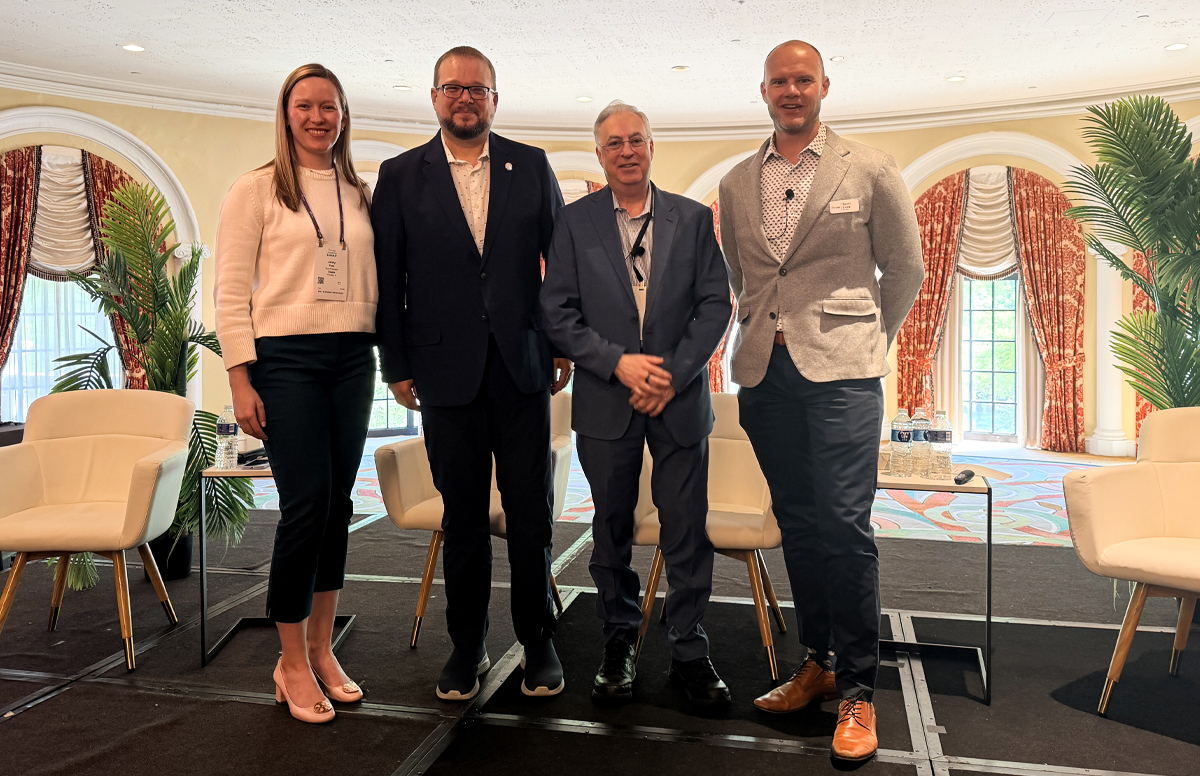
To explore the broad, evolving, and always popular topic of emerging technologies in aging services, the Center for Aging Services Technologies’ (CAST) Scott Code assembled a diverse panel of experts with expertise in three distinct areas of aging services—provider, technology procurement and supports, and technology investment—at Leadership Summit 2026.
Participants (pictured left to right with Code) were Jenny Poth, vice president at LeadingAge Gold Partner with CAST Focus Ziegler, the investment bank with Ziegler Link•Age Funds, focused on tech innovations; Justin Smith, senior innovation and technology manager at Direct Supply, a senior living-focused technology and procurement firm and David Finkelstein, chief information officer (CIO) at LeadingAge member RiverSpring Living, a CAST Patron. The presenters also covered specific solutions and innovations they’re seeing used in familiar areas like social connection and engagement, safety and activity monitoring, health and wellness, and operational efficiencies, while touching on examples of investment trends. Their conversation wrapped up with recommendations for providers interested in testing the latest tech.
Engagement Technologies
Social connection and engagement technologies, for many years a critical category in aging services technology, continues to be a focus for investors and providers. Not surprisingly, a plethora of new artificial intelligence (AI) applications are emerging. Sharing details of his organization’s pilot of Meela, an AI‑powered voice chatbot that regularly calls residents to engage in open‑ended conversations, RiverSpring Living’s Finkelstein noted chatbots’ ubiquity: “There are hundreds of them out there.”
What makes the investment of staff time and resident participation with Meela worthwhile, he says, is that beyond companionship, the chatbot helps surface insight that can prompt follow-up by staff. “We’re not only [using] this for interactive conversations,” Finkelstein said, “but we’re trying to use the data that comes out of these conversations to make meaningful and useful [decisions] for the residents that we serve.” Findings from a clinical trial conducted by RiverSpring over the last quarter of last year, and with about 50 subjects across skilled nursing, independent and assisted living, he said, “showed before-and-after statistically significant reductions in anxiety, isolation and loneliness.”
Bringing an investor perspective, Ziegler’s Poth noted that in the engagement realm, “the name of the game right now is personalization, and very subtle personalization.” As an example, she pointed to a “very comprehensive” engagement platform called TSO Life that “particularly works on the front end, when a resident is moving in, to really deeply understand what makes them tick.” TSO listens to residents’ intake conversations—noting preferences, hobbies, personal details like hometown or high school—and uses that information to develop recommendations on how that resident can get engaged with the community. Her take: “It integrates and operates its community functions in a way that’s different.”
Safety Technologies
On the safety and activity monitoring front—another popular category for technology development—Poth noted current conversations around fall detection and preventions: What does it look like to detect, to prevent, or predict a fall? Elopement management, she said, is evolving, with a look at ensuring the safety of those who are prone to wandering. But a company that’s really caught her attention is called ‘Wear Tech,’ offering solutions that can be customized for each individual in a community, using AI to develop geographic boundaries based on specific habits. “It’s a big upgrade from just an alarm that goes off every time someone goes out of that door and forgets to press the button on the side beforehand,” she said.
Picking up on the breadth of potential tech solutions in falls prevention, Direct Supply’s Smith noted that the growth in offerings presents some challenges for providers. “I don’t know that there is a singular solution that kind of works for everybody.”
For RiverSpring, experimentation with new products was key. “We learned from our failures,” Finkelstein said, providing details on the organization’s trial-and-error with fall detection sensors. His search for a full fall prevention solution continues. “I would love to have a solution that’s doing full prevention. Many vendors are reporting that they have something like that, but I have not seen something that I’d be willing to pilot and trial in our organization, because that’s the Nirvana. We would love to predict and prevent falls.”
Health and Wellness Technologies
Moving to emerging health and wellness technologies, including telehealth, behavioral health services, robotics, and remote patient monitoring, Poth cited two companies in which Link•age has invested: Third Eye Health, which provides off-hours telehealth coverage to skilled nursing providers, and Precise Behavioral. Through one vendor, it brings psychiatry, psychology, and therapy into a facility, both in person and via telehealth, depending on what is preferred, with dedicated providers each time.
Offering up the provider’s perspective, RiverSpring’s Finkelstein shared that his organization’s physician practice uses a robot to summon them to a resident’s room if a physician’s visit off hours is needed. The robot can handle tasks like starting a telemedicine visit, and it can work with the on-call nurse. The outcome: It “really reduced the number of out to hospital transitions that we needed to do.” Other RiverSpring explorations: a zero lead EKG machine and pharmacogenomics.
Operational Efficiencies
Operational efficiency rounded out the session. Automated vital-sign collections, for instance, reduced documentation time and freed staff capacity at RiverSpring Living. “What we are able to do is transition the responsibility from the nurse to the certified nursing assistant (CNA),” said Finkelstein. “And take the time that it takes to record all these vital signs and get it into the medical record from five to six minutes down to 30 seconds … we freed up eight hours per week for each RN to be able to do more work with the residents or other things.”
Best Practices for Finding a Good Technology Match
Circling back to the question of best practices for organizations interested in exploring new technologies, panelists emphasized disciplined experimentation, staff trust, and clarity of purpose.
“One of the ways that you can determine what you’re going to do first is figuring out where do you have staff buy‑in,” Poth said, noting that pilots are more successful when teams understand both the goals and the possibility that a technology may be removed if it does not deliver results.
Smith cautioned against what he described as “pilot purgatory,” where solutions are tested but never scaled. Planning for success, or exit, should happen before a pilot begins. Finkelstein stressed the importance of strong foundations, from infrastructure and interoperability to governance and peer learning.
The session made clear that many emerging tech-based tools are already delivering meaningful benefits, but only when adoption is intentional, transparent, and aligned with resident needs. For providers who want to experiment, a good first step, says Direct Supply’s Smith, is understanding your resident population.” ”Focusing on the problem that you’re trying to solve … would be my advice on where to start.”

 TEP Report Hints At Home Health Value Based Purchasing Potential Changes